SBPA Brings Voice of Main Street Small Business to Capitol Hill

Tenth Washington Fly-In Follows SBPA Panel at CHCI Leadership Conference Highlighting Importance of Electronic Payments for Entrepreneurs

Washington, DC — Members of the Small Business Payments Alliance (SBPA) returned to Capitol Hill this week for the organization’s 10th Washington fly-in, marking a major milestone in its effort to ensure that small business owners have a voice in debates over the future of the electronic payments system. The visit comes on the heels of SBPA’s participation in the Congressional Hispanic Caucus Institute’s 2026 Leadership Conference, where small business owners and policy leaders discussed how electronic payments help entrepreneurs reach customers, manage their businesses, and pursue new opportunities for growth – and the potential impact of federal and state credit card mandates on small businesses. 

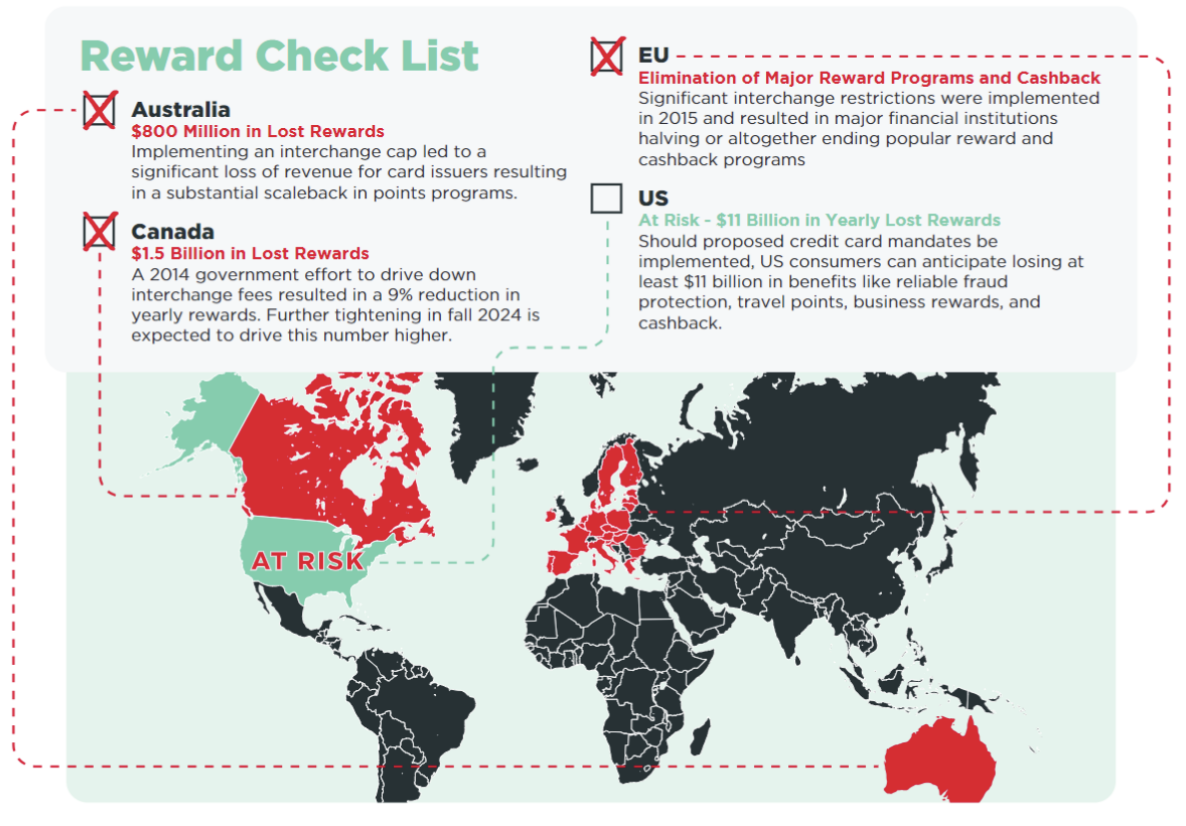
Ten fly-ins represent hundreds of conversations with lawmakers, providing an opportunity for members of Congress to hear directly from the small business owners who actually use the electronic payments system every day. Throughout these meetings, small business owners are delivering a consistent message: credit cards help small businesses manage cash flow, reach more customers, and grow their businesses. Congress should listen to these Main Street entrepreneurs and reject federal credit card mandates like Durbin-Marshall.

At last week’s CHCI Leadership Conference, SBPA members Maritza and Malki Higuera, owners of M&M Family Orchard in Arizona, joined Arizona State Representative Alma Hernandez and Nicole Duerler-Montant of the Latino Economic Development Center for a discussion moderated by Telemundo’s Alberto Pimienta and opened by Rep. Lou Correa (D-CA). The panel focused on how the global electronic payments system can expand customer access and economic opportunity for Main Street businesses, while examining concerns about how the Durbin-Marshall credit card mandates and state-level interchange proposals could affect Latino entrepreneurship. The discussion built on SBPA’s broader advocacy on behalf of small businesses, including the effort to protect the security and convenience of the existing electronic payments system.

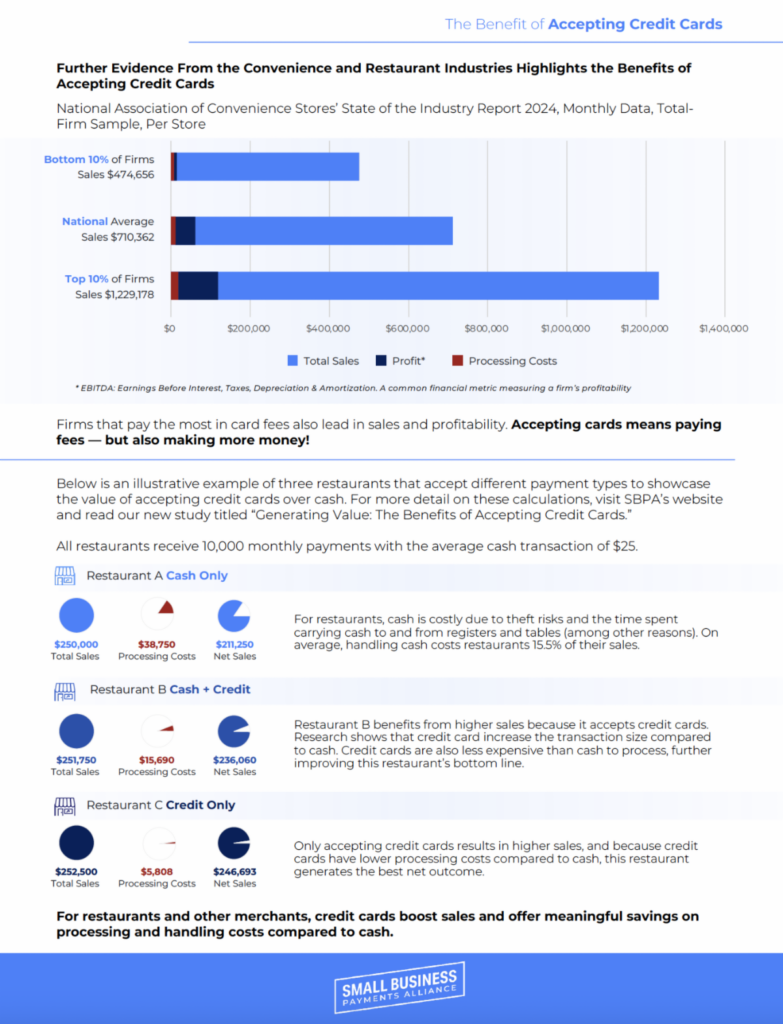
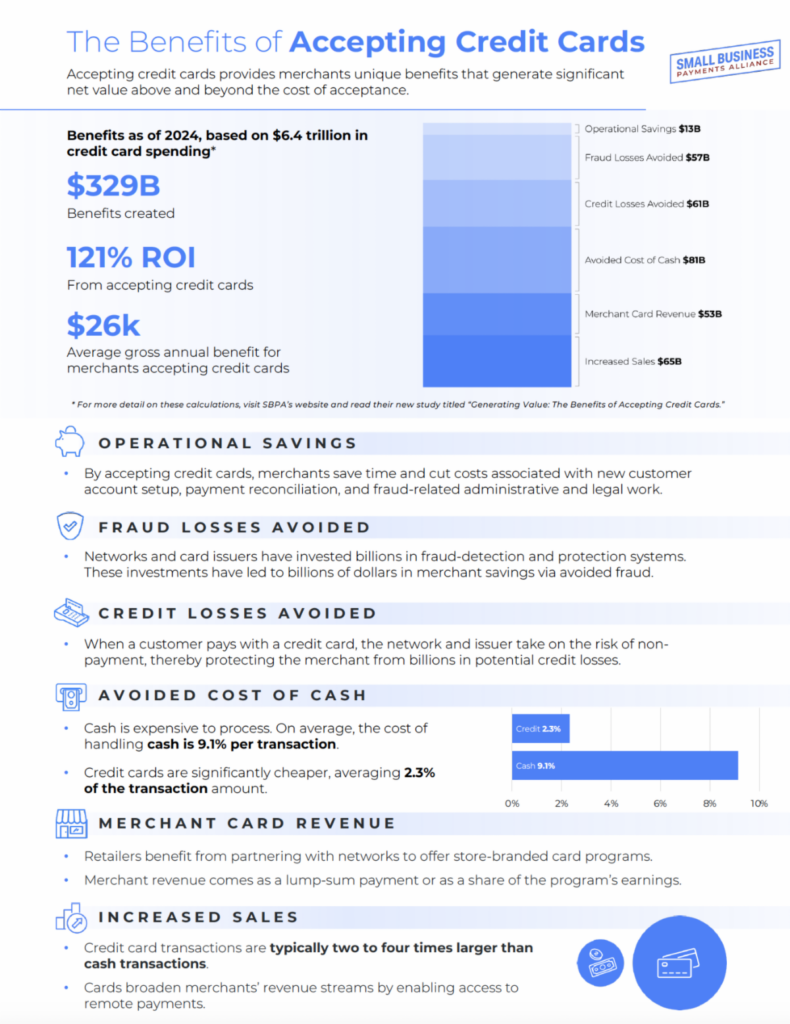
Small businesses see firsthand that accepting credit cards isn’t a cost — it’s an investment. A recent study detailed that small businesses see a 121% return on investment from credit cards, with an average of $26,000 in annual benefits through higher sales, security, and customer convenience. The Durbin-Marshall credit card mandates would undermine those gains, inject risk into the payments system, and ultimately make it harder for small businesses to compete and grow.

A copy of the full report can be found here.
New Report Affirms Value of Credit Cards for Small Business

The Small Business Payments Alliance (SBPA) issued a report today containing new data that affirms the value of credit cards for small businesses. According to consumer surveys and new research conducted over the first quarter of 2024, credit cards remain a top funding source for small and medium-sized businesses.

SMALL BUSINESS ELECTRONIC PAYMENTS STATUS REPORT – RHODE ISLAND

Small businesses are the backbone of Rhode Island’s economy. Rhode Island’s more than 105,000 small businesses employ approximately 228,000 Rhode Island residents – more than 51 percent of the state’s private sector workforce. Small businesses in Rhode Island rely on credit cards and rewards to lower operating costs, re-invest in their businesses and employees, manage cash flow, and give customers more choice, security, and convenience in how they pay.

SMALL BUSINESS ELECTRONIC PAYMENTS STATUS REPORT – UTAH

Small businesses are the backbone of Utah’s economy. Utah’s more than 333,000 small businesses employ over 635,000 Utah residents – 45 percent of the state’s private sector workforce. Small businesses in Utah rely on credit cards and rewards to lower operating costs, re-invest in their businesses and employees, manage cash flow, and give customers more choice, security, and convenience in how they pay.

SMALL BUSINESS ELECTRONIC PAYMENTS STATUS REPORT – TEXAS

Small businesses are the backbone of Texas’ economy. Texas’ 3.2 million small businesses employ 5 million Texas residents – more than 44 percent of the state’s private sector workforce. Small businesses in Texas rely on credit cards and rewards to lower operating costs, re-invest in their businesses and employees, manage cash flow, and give customers more choice, security, and convenience in how they pay.

SMALL BUSINESS ELECTRONIC PAYMENTS STATUS REPORT – VERMONT

Small businesses are the backbone of Vermont’s economy. Vermont’s nearly 77,000 small businesses employ approximately 156,000 Vermont residents – more than 60 percent of the state’s private sector workforce. Small businesses in Vermont rely on credit cards and rewards to lower operating costs, re-invest in their businesses and employees, manage cash flow, and give customers more choice, security, and convenience in how they pay.

SMALL BUSINESS ELECTRONIC PAYMENTS STATUS REPORT – TENNESSEE

Small businesses are the backbone of Tennessee’s economy. Tennessee’s nearly 665,000 small  businesses employ 1.2 million Tennessee residents – about 42 percent of the state’s private sector workforce. Small businesses in Tennessee rely on credit cards and rewards to lower operating costs, re-invest in their businesses and employees, manage cash flow, and give customers more choice, security, and convenience in how they pay.

SMALL BUSINESS ELECTRONIC PAYMENTS STATUS REPORT – SOUTH CAROLINA

Small businesses are the backbone of South Carolina’s economy. South Carolina’s nearly 480,000 small businesses employ approximately 840,000 South Carolina residents – more than 42 percent of the state’s private sector workforce. Small businesses in South Carolina rely on credit cards and rewards to lower operating costs, re-invest in their businesses and employees, manage cash flow, and give customers more choice, security, and convenience in how they pay.

SMALL BUSINESS ELECTRONIC PAYMENTS STATUS REPORT – NORTH CAROLINA

Small businesses are the backbone of North Carolina’s economy. North Carolina’s 1 million small businesses employ 1.8 million North Carolina residents – nearly 45 percent of the state’s private sector workforce. Small businesses in North Carolina rely on credit cards and rewards to lower operating costs, re-invest in their businesses and employees, manage cash flow, and give customers more choice, security, and convenience in how they pay.

SMALL BUSINESS ELECTRONIC PAYMENTS STATUS REPORT – NEVADA

Small businesses are the backbone of Nevada’s economy. Nevada’s more than 312,000 small  businesses employ approximately 542,000 Nevada residents – nearly 43 percent of the state’s private sector workforce. Small businesses in Nevada rely on credit cards and rewards to lower operating costs, re-invest in their businesses and employees, manage cash flow, and give customers more choice, security, and convenience in how they pay.